
[2026 Ultimate Guide] Pipe Chamfering Machine: Working Principles, Types, and ROI Sizing Strategy
Meeting the strictest welding standards: How to eliminate bottlenecks and achieve perfect weld preps every time.
|
📅 Updated: Feb 2026
|
⏱️ Read Time: 10 Min
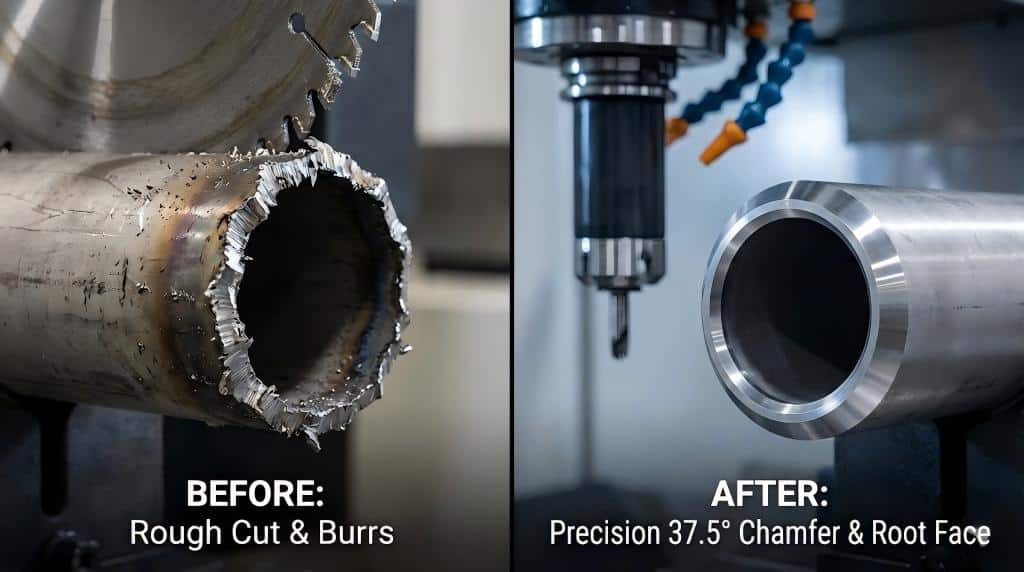
In modern metal tube processing, front-end fiber tube lasers and circular saws are cutting faster than ever. However, if your back-end tube end preparation still relies on manual angle grinders, your production line will instantly hit a massive bottleneck.
Manual grinding isn't just slow; it creates wildly inconsistent bevel angles. These inconsistencies directly cause fatal welding defects in downstream processes, such as porosity and incomplete joint penetration.
This guide explores the working principles of professional pipe chamfering machines. From semi-automatic units to fully automatic CNC lines, we will provide a clear 2026 equipment sizing and ROI checklist to help you conquer the final hurdle of your tube production line.
1 What is a Pipe Chamfering Machine?
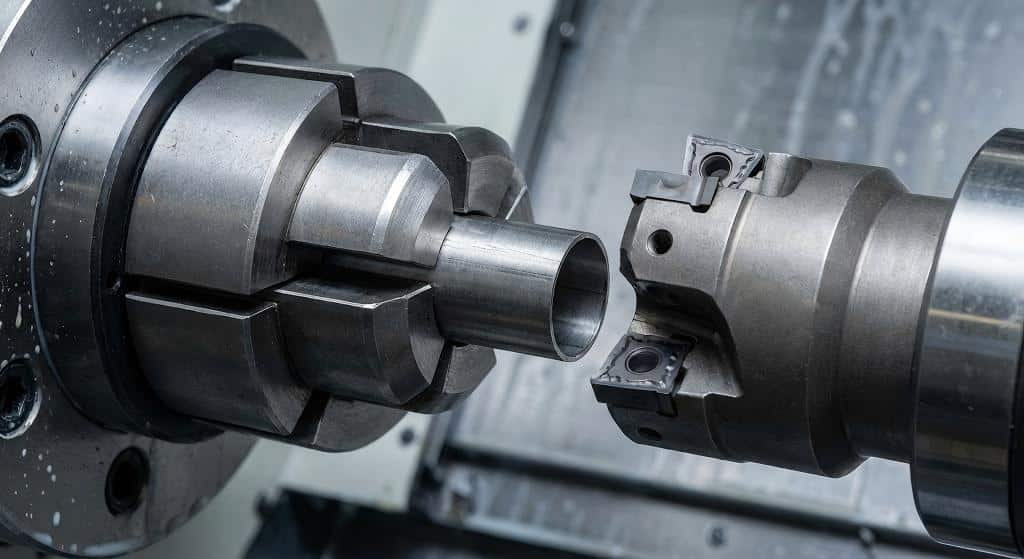
A pipe chamfering machine is a specialized industrial equipment used to mechanically machine the ends of metal tubes or solid bars. By utilizing rotating cutting heads with custom inserts, it rapidly cuts the metal to form specific angled bevels (e.g., 30°, 37.5°, 45°) or flat facing surfaces, preparing the tube for precise orbital welding or safe assembly.
2 Why Industrial Manufacturing Cannot Rely on Angle Grinders
The transition from manual tools to professional equipment is driven by strict quality control and labor costs.
- Meeting Strict Welding Standards: International codes like ASME B16.25 and AWS D1.1 demand precise bevel preparations. A machine guarantees the exact root face (land) and bevel angle required for full-penetration robotic welding.
- Safety & Deburring: Sharp, jagged edges from saw cutting destroy O-rings and hydraulic seals during assembly. A machine simultaneously chamfers the OD (Outside Diameter), ID (Inside Diameter), and faces the end, removing all burrs in one 3-second cycle.
- Boosting Assembly Efficiency: Standardized, uniform tube ends ensure that automated welding tractors and robotic arms don't have to pause and adjust parameters for every single joint.
📢 Process Deep Dive: Which Bevel Do You Need?
Different wall thicknesses require different prep angles to ensure proper weld fusion.
👉 Read: Illustrated Guide: 5 Most Common Pipe Welding Bevels (V, U, J) & Applications
🤔 Unsure about the correct bevel standard for your project?
Send us your tube drawings. Our engineers will provide a free Process Analysis & Cycle Time Report within 24 hours.
3 Top 3 Mainstream Classifications of Pipe Chamfering Machines
Choosing the right equipment depends entirely on your factory's production volume and labor setup.
1. Manual / Portable Bevelers (Flexible but Inefficient)
These are handheld tools that clamp onto the pipe ID or OD. They are highly flexible and perfect for on-site construction or pipeline repair. However, they are too slow for factory environments, making the per-piece labor cost extremely high.
2. Semi-Automatic (Pneumatic / Hydraulic)
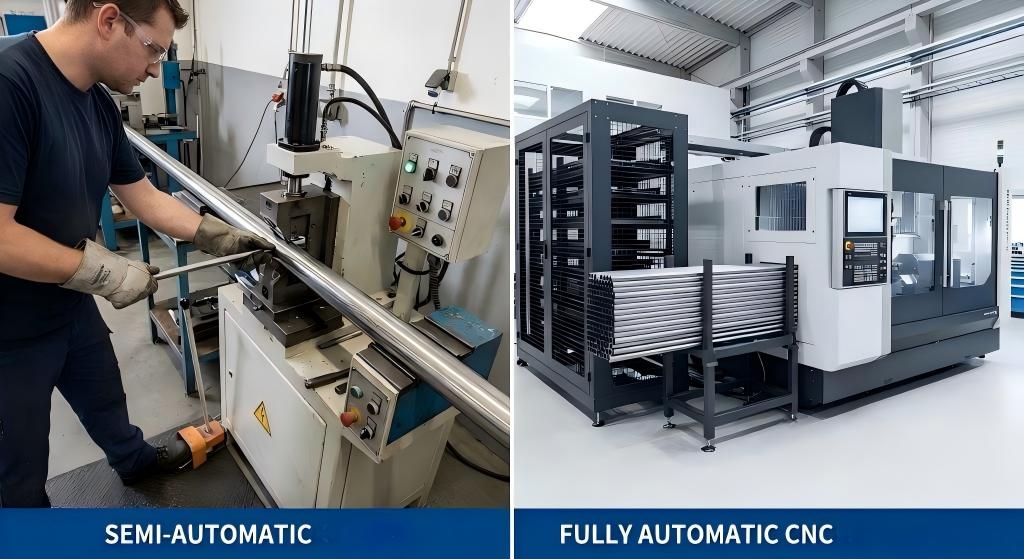
The operator manually loads the tube, steps on a foot pedal, and the machine automatically clamps and feeds the cutting head. This is the highest ROI transitional solution. It requires a lower initial investment than full CNC but guarantees 100% consistency in bevel quality.
3. Fully Automatic CNC (The Ultimate Volume Solution)
Equipped with an automatic loading rack (BTM) and unloading systems, these machines run unattended. They are ideal for high-volume sectors like automotive exhaust tubes, boiler manufacturing, and furniture tubing.
💡 Tony's Floor Experience
"Don't buy a fully automatic CNC machine if you change tube diameters 5 times a day. The setup time will kill your efficiency. For HMLV (High-Mix Low-Volume) production, a robust semi-automatic hydraulic machine is actually your most profitable choice."
4 Core Parameters to Check Before Buying
To avoid the sunk cost of purchasing the wrong equipment, you must provide your supplier with these precise technical details.
- 1. Tube Diameter Range (OD & ID): Machines are sized by capacity (e.g., OD 10mm-50mm, or OD 50mm-114mm). Pushing a small machine to do maximum capacity daily will burn out the spindle.
- 2. Maximum Wall Thickness: A 2mm exhaust pipe and a 15mm high-pressure boiler tube require completely different motor power ratings and cutting torques.
- 3. Tube Material: Carbon steel, 304 stainless steel, and titanium behave differently. Stainless steel requires specific carbide inserts and a rigid machine bed to prevent work-hardening.
- 4. Target Cycle Time: If you need to process 10,000 pieces per shift, you must calculate the machine's feed rate to decide between single-head or double-head (simultaneous both ends) configurations.
- 5. Fixture Type: For thin-walled tubes (wall < 1.0mm), standard V-block clamps will crush the pipe. You must specify full-wrap profile clamping jaws.
2026 Equipment Selection & ROI Matrix
| Machine Type | Best For | Cycle Time (OD 50mm) | Operator Needed | Estimated ROI Break-even |
|---|---|---|---|---|
| Manual / Portable | On-site repair, < 50 pcs/day | 60 - 120 seconds | 1 Dedicated Worker | Immediate (Low CapEx) |
| Semi-Auto (Hydraulic) | Job shops, HMLV production | 3 - 6 seconds | 1 Loading Operator | 4 - 6 Months |
| Fully Auto CNC | Mass production, > 5000 pcs/day | 2 - 4 seconds | 0.2 (Supervising line) | 8 - 12 Months |
Frequently Asked Questions (FAQ)
On a semi-automatic machine, changing the clamping jaws and adjusting the cutter head takes a skilled operator about 10-15 minutes.
It shouldn't, if the machine is built right. We use heavy cast-iron bases and variable frequency drives (VFD) to adjust the spindle RPM, eliminating chatter marks on stainless steel.
Yes. By simply swapping the cutting insert profile, the same machine can bevel and face solid steel bars for lathe preparation.
For mild steel, dry cutting is usually fine. For stainless steel, aluminum, or heavy wall cutting, a flood coolant system is highly recommended to prolong tool life.
Yes, this is the standard setup. The cutter head houses three distinct carbide inserts set at different angles to perform all three operations in a single plunge.
Stop Grinding. Start Machining.
The era of manual angle grinders is over. Don't let your backend tube preparation dictate the speed of your entire factory. Upgrade to a professional pipe chamfering machine and guarantee perfect weld prep every time.
Get a Custom Equipment & ROI Proposal
Send us your tube dimensions (OD, Wall Thickness), material specs, and required bevel angles. Our engineering team will provide a precise Cycle Time Analysis and machine configuration within 24 hours.