
The 2026 Ultimate Guide: Top 10 Gear Manufacturing Companies & Selection Strategy
Subtitle: When NVH Becomes the New "Horsepower": How to Choose a Partner in the e-Drive Era.
Author: Tony, Senior CNC Consultant (20+ Years Exp.)
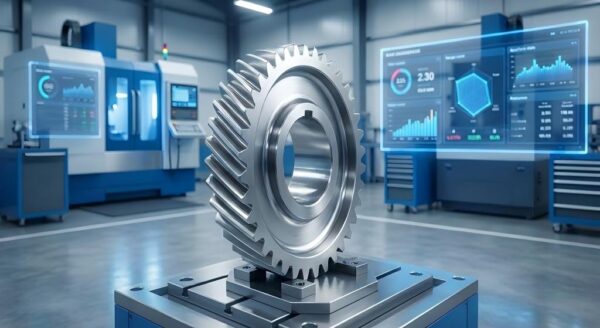
Figure 1: The New Standard: A dust-free, temperature-controlled environment is mandatory for polishing EV gears to prevent thermal deformation.
👋 Silence is Gold, and the Most Expensive Barrier
Hi there! As a veteran who has rolled in the gear machining trenches for over 20 years—witnessing the shift from manual mechanical shifting to the current e-Drive explosion—I need to give it to you straight: In the 2026 gear race, it’s no longer about "Can you cut it?"; it’s about "Can you cut it silently?"
The current automotive industry, especially Electric Vehicles (EVs), has developed a near "obsessive" requirement for NVH (Noise, Vibration, and Harshness). Even a mere $1\mu m$ of tooth profile error can be amplified into an ear-piercing whine under the high-frequency vibration of an electric motor. To help you avoid procurement pitfalls, I have compiled this field guide based on the latest 2026 mass production standards.
1. In 2026, How Do We Measure a Gear Factory?
I remember 20 years ago, we were discussing how to pull back deformation after heat treatment—that was for "durability." But by 2026, if you visit a top-tier gear workshop, you will find that "Grinding" has become the standard. Because e-Drive systems often spin at 18,000 RPM or more, tiny surface textures (Ghost Noise) are now the killers of vehicle quality.
The entry threshold for high-end gear manufacturing in 2026 has risen to DIN 4 quality or better. Core metrics include: Gear Surface Roughness $Ra < 0.2\mu m$, 100% Closed-loop Measurement supporting Digital Twins, and EV-specific Polish Grinding technology. This is not just for durability; it is to pass the rigorous NVH Audits.
A scientific 2026 gear supplier evaluation system must include four core dimensions: First, Micro-geometry control capability targeting high-frequency whine; Second, single-piece carbon footprint transparency based on ISO 14064 standards; Third, fatigue strength margin for 18,000+ RPM; and Fourth, the ability of Digital Twins to predict machining anomalies in real-time.
💡 Consultant Insight: Reading Metrics from the "Shop Floor"
-
Field Phenomenon: Many factories are still using old-school "Hobbing + Shaping" processes for e-Drive Internal Ring Gears. The result? Extremely low efficiency, and the gear alignment errors cause noise levels to exceed limits after assembly.
-
Technical Analysis: A traditional scheme might take 8 minutes to machine an internal ring gear. The 2026 scheme uses Power Skiving, combined with hard cutting technology, compressing the cycle time to under 90 seconds while maintaining DIN 6 precision.
-
Consultant Advice: If your production line is for Internal Ring Gears, I suggest skipping second-hand traditional shapers entirely. Even if the machine is 40% cheaper, the extra process costs and high scrap rate will make your OEE (Overall Equipment Effectiveness) look terrible. Selection isn't just buying machines; it's buying profit. I suggest referring to this [2026 Gear Line TCO (Total Cost of Ownership) Guide].
2. Top 10 Global Gear Manufacturing Companies & Tech Service Giants (2026)
This list isn't just about who is the biggest; it's about who holds the "Silence Code" of 2026. I have curated the top global players based on recent field delivery quality, technical response speed, and adaptability to EV trends.
Leading gear enterprises in 2026, such as Gleason (Precision Equipment), ZF (Driveline Integration), Klingelnberg (Metrology & Bevel Gears), and Reishauer (Grinding), have established the technological high ground in the global EV supply chain by integrating AI monitoring with super-finishing capabilities.
| Manufacturer / Service Provider | Core Advantage Metric | 2026 Keyword Matrix | Recommended Path (Best For) |
| Gleason | Polish Grinding Integration | NVH Optimization, Closed-loop | High-performance e-Axle gears, chasing extreme silence. |
| ZF | Full Driveline Integration | e-Driveline, Sustainability | Full vehicle transmission outsourcing. |
| Klingelnberg | Gear Metrology Centers (P-Series) | Digital Twin, ISO 1328 | R&D Testing Centers, High-precision bevel gears. |
| Reishauer | Continuous Generating Grinding | High-speed Grinding, OEE | High-volume, high-consistency mass production lines. |
| Bosch | Sensor-Integrated Gearboxes | AI-enabled, IoT Sensors | Smart chassis drives requiring data interaction. |
| BorgWarner | Compact e-Axle Design | Space Efficiency, iDM | Compact EV powertrains. |
| Aisin | Hybrid Transmission Efficiency | Hybrid Efficiency, TCO | Hybrid vehicle gearboxes. |
| Magna | Torque Vectoring Systems | Torque Vectoring | 4WD and torque distribution systems. |
| Schaeffler | Bearing & Gear Coupling | Friction Reduction | Energy-saving shaft system integration. |
| Qinchuan / Haitian | High Cost-Performance Lines | ROI, Power Skiving | Rapid capacity expansion, high-value alternatives. |
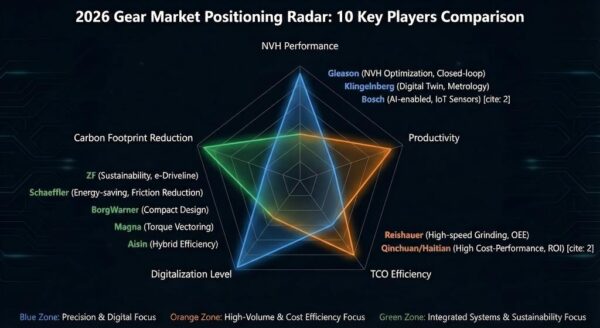
Figure 2: The 2026 Gear Manufacturing Companies Performance Radar: Visualizing the "Silence vs. Cost" trade-off between Tier 1 Mold Masters and Tier 3 Entry-level machines.
The hard indicators for judging whether a gear factory meets the 2026 e-Drive standard are: The Gear Quality pass rate must remain at a 6-Sigma level, the thermal displacement compensation accuracy during spindle machining must reach $\pm 2\mu m$, and the Mean Time Between Failures (MTBF) must not be lower than 12,000 hours.
3. Decision Path: If-Then Strategy & "Traps"
In 2026, you must reverse-engineer your production line logic based on product positioning.
📽️ Video Description Experience: The Future of Grinding
Imagine standing in front of a brand new 2026 Gear Grinding Machine. Through the anti-reflective observation window, you don't see a messy flood of coolant. Instead, you see a precision-targeted internal cooling system. The moment the grinding wheel touches the gear flank, Acoustic Emission (AE) Sensors capture the signal. The waveform jumping on the screen isn't current; it's the micron-level displacement after dynamic compensation—the machine is "listening" to the gear quality.
🚦 attention:
-
If your goal is a Luxury EV Sedan with Extreme Silence -> Then you must deploy 100% Super-finishing (Polish Grinding). If you are struggling with "whine" during road tests, check my previous analysis on [Why Ra 0.2μm Decides NVH Success].
-
If your focus is High-Volume, Low-Cost Commuter Cars -> Then prioritize Hard Hobbing technology to optimize TCO by skipping the grinding process.
-
If you are developing High-Performance 4WD Torque Vectoring -> Then you must choose an integrated supplier that supports AI Real-time Torque Monitoring.
⚠️ The "Comparison Trap" Warning:
Do not be fooled by ads claiming "Dry Cutting saves all coolant costs." Under 2026 standards, while Dry Cutting is eco-friendly, it causes thermal deformation of the gear blank during heavy material removal. If your machine is not equipped with a "Closed-loop Thermal Compensation System," you will find the gears cut in the afternoon are a completely different breed from those cut in the morning!
4. Top 5 FAQ for Engineers & Procurement
Q1: Why do we pursue $Ra < 0.2\mu m$ roughness? Didn't 0.8 work fine before?
A: Because the RPM changed. Traditional ICE engines had low spindle speeds, and gear noise was masked by the engine roar. Current EV gears spin 3x faster. The "High-frequency Harmonics" generated by 0.8μm will cause customers to directly complain about the "whistling" sound. This is a transition from a "Functional Part" to an "Art Piece."
Q2: How do we solve the hidden danger of "Grinding Burn"?
A: The traditional method of operators checking color is too unreliable. The 2026 solution is integrating Barkhausen Noise Detection. This non-destructive testing judges whether the hardness layer is damaged directly on the machine, with 99.9% accuracy.
Q3: Why have Chinese gear grinders become strong competitors in 2026?
A: Algorithms. Current domestic machines (like Qinchuan, Hanjiang) are no longer inferior in hardware rigidity. The key is their development of open CNC compensation algorithms, which can make targeted corrections for the instability of domestic raw material heat treatment. The cost-performance ratio and response speed are impressive.
Q4: Will the ISO 14064 Carbon Audit really reach the factory floor?
A: Yes, and soon. European OEMs now demand "Carbon Emission Data per Gear." If your factory is still using inefficient old equipment, your "Energy Cost per Part" will cause you to lose overseas orders. Don't wait until orders are rejected to care about compliance; I detailed this in [The 2026 Gear Export Carbon Footprint Audit Points].
Q5: Facing speeds over 18,000 RPM, should we choose Electric Spindles or Mechanical Spindles?
A: For 2026 high-precision demands, I recommend Built-in Direct Drive Electric Spindles. Although initially more expensive, they eliminate the Backlash of the transmission chain. On the road to DIN 4 precision, this is the most worry-free configuration.
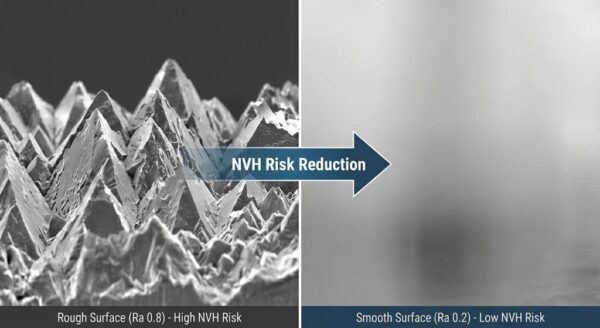
Figure 4: The Noise Source: The jagged peaks of Ra 0.8 (left) create high-frequency whine, while the Ra 0.2 mirror finish (right) ensures silence.
🤝 Conclusion: We Are Choosing More Than Just Machines
We are not just selecting a set of production equipment; we are choosing a Green Foundation capable of adapting to the 2026 Carbon Footprint Audit; we are choosing a Tech Partner who can solve the e-Drive whine puzzle; we are choosing a Smart Terminal that ensures the factory never falls behind in the digital wave.
Tony
Senior CNC Consultant, focusing on Gear Manufacturing & NVH Optimization for 20 years. Lead multiple localization projects for e-Drive gear lines and European technology transfers. I believe "Every micron has a soul."
🚀 Start Your 2026 Line Audit
Facing NVH whine issues or OEE efficiency bottlenecks? I can provide you with an equipment selection report based on the TCO model.
👉 [Click to Book: Gear Line Digital Upgrade 1-on-1 Consultation]
🤖 Dear reader, thank you for reading this far. This guide is given soul by a veteran consultant with 20 years of experience, and modeled/optimized by an efficient AI assistant. We hope that through this perfect handshake of human insight and machine logic, we can help you secure victory in the manufacturing wave of 2026. May every one of your gears be as precise as a timepiece and as quiet as silk.
Deep Dive Resources & Industry Standards:
-
Technical: Ra 0.2μm Truth: Why Micro-texture Decides NVH Success
-
Financial: 2026 Gear Line TCO Model: Balancing DIN 4 Accuracy & Cost
-
Compliance: From ISO 14064 to Green Deal: The New Carbon Threshold
-
Official Standards: For the latest global definitions on gear accuracy and inspection (ANSI/AGMA 2015), I recommend referring directly to the American Gear Manufacturers Association (AGMA).