
Say Goodbye to Manual Grinding: The True ROI & Cost Standards of Automatic Pipe Chamfering Machines
A CFO's guide to justifying the investment: How to replace labor bottlenecks with exponential efficiency.
|
📅 Updated: March 2026
|
⏱️ Read Time: 11 Min
As skilled labor shortages worsen and hourly wages climb, relying entirely on manual labor for high-volume tube deburring and beveling is silently devouring your profit margins. To maximize your Automatic Pipe Chamfering Machine ROI, you must rethink your backend process.
Many factory owners hesitate to procure automated equipment, perceiving the initial cost as too high. However, they overlook the hidden costs of manual grinding: skyrocketing scrap rates, delayed deliveries, and exorbitant worker's compensation claims from vibration injuries. These invisible expenses often dwarf the price of a machine.
Introducing an automatic pipe chamfering machine is not an expense—it is a high-yield investment. This guide breaks down the cost structure, explores the efficiency gains, and provides a clear ROI calculation to help you make an informed decision.
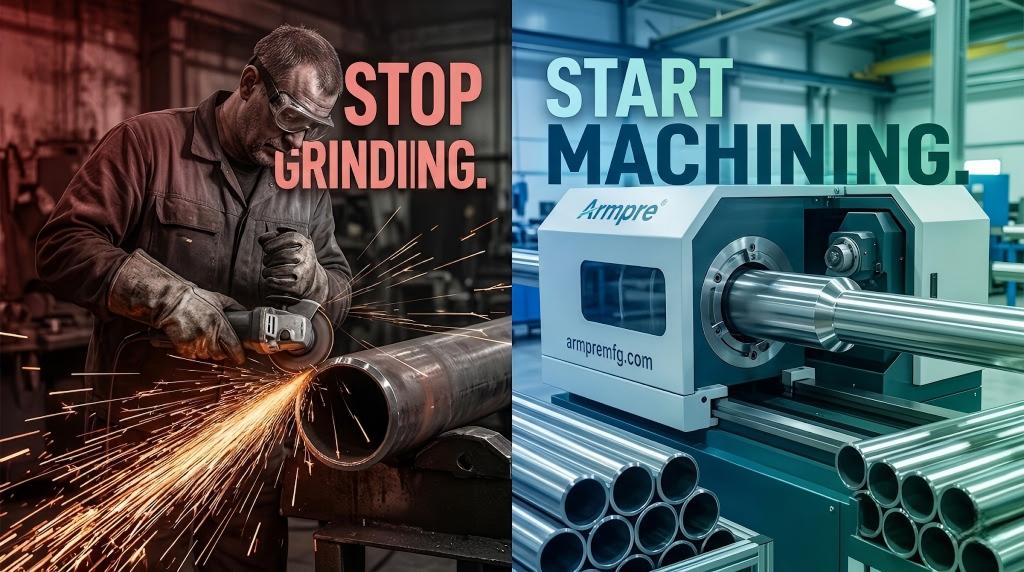
1. The 4 Invisible Costs of Manual Pipe Beveling
Before calculating returns, we must accurately measure the current bleed. Manual grinding drains your budget in four distinct ways:
- Labor Inflation: A grinder operator costing $25/hr equals $50,000 annually. If you run three shifts, that’s $150,000 spent just on payroll.
- The Scrap Multiplier: Inconsistent manual bevels lead to rejected welds. Scrapping a $50 stainless steel tube because of a bad 50-cent grind is an unacceptable loss.
- Abrasive Consumables: Grinding discs wear out fast. High-volume shops can burn through thousands of dollars in abrasives monthly.
- Safety Liabilities: Prolonged angle grinder use causes Hand-Arm Vibration Syndrome (HAVS). According to
OSHA guidelines,
eliminating the vibrating hand tool entirely by upgrading to automated CNC machinery is the best way to prevent massive insurance premiums and medical claims.
📉 Quality Control Deep Dive
Are inconsistent bevels ruining your automated welding parameters?
👉 Read Article: 3 Key Strategies to Reduce Tube Processing Scrap Rates
2. How Automation Achieves Exponential Cost Reduction
Capacity Showdown: 15 pcs/min vs. 2 pcs/min
A skilled worker using a hand tool might complete 2 pipe ends per minute. An Armpre double-end automatic machine processes both ends simultaneously, easily achieving 15 pieces per minute on standard automotive exhaust tubes. This 750% increase in throughput immediately clears downstream bottlenecks.
Quality Stability: The Cpk Advantage
Machines do not get tired at 4:00 PM. By using rigid linear guideways and servo-driven feeds, automatic machines maintain a Process Capability Index (Cpk) > 1.33. This means the bevel angle and root face remain identical from the first piece to the ten-thousandth, ensuring 100% compliance with ASME welding codes.
📊 Want to know your exact Break-Even Point?
Stop guessing. Let Tony run your numbers. Send us your hourly wages and daily volume, and we'll generate a custom Financial Justification Report for your management team.
3. Deep Dive: Calculating the ROI
Let’s look at the hard numbers. Below is a comparative financial breakdown based on a real factory processing 2,000 tubes per day (4,000 chamfered ends) over a single shift.
Annual Cost Comparison: Manual vs. Fully Automatic
| Cost Category (Annualized) | Manual Grinding (4 Operators) | Armpre Automatic (1 Operator) |
|---|---|---|
| Direct Labor ($25/hr) | $200,000 | $50,000 |
| Consumables (Discs vs Carbide) | $18,000 | $2,500 |
| Rework & Scrap (Estimated 3%) | $15,000 | $500 (< 0.1%) |
| Total Operating Cost | $233,000 / Year | $53,000 / Year |
💰 Direct Savings: $180,000 Annually. Machine Payback Period = ~4.5 Months.
4. Real Factory Modification Case Study
In January 2026, an automotive exhaust manufacturer in Ohio replaced their 4-station manual grinding line with a single Armpre Double-End CNC Chamfering Machine.
The results were immediate. Not only did they reassign three workers to higher-value welding tasks, but their robotic welding cell efficiency jumped by 22% because the robots no longer had to compensate for uneven root gaps.
ROI & Equipment FAQ
For factories running 2+ shifts or high volumes (>2000 pcs/day), the static payback period is generally between 4 to 8 months. Labor and scrap savings accumulate rapidly.
No. Unlike abrasive wheels that vanish into dust, carbide inserts have 3-4 cutting edges. One insert can process thousands of tubes before needing rotation, dropping cost-per-part to fractions of a cent.
Absolutely not. Modern PLC controls use conversational touchscreens. The operator simply inputs the tube diameter and length, and the machine adjusts itself.
Armpre machines utilize quick-change jaw systems. Switching from a 2-inch to a 3-inch tube setup takes less than 10 minutes, keeping HMLV (High-Mix Low-Volume) production highly profitable.
Yes. Many of our clients use equipment leasing. The monthly lease payment is often significantly lower than the monthly wages of the manual grinders they replaced, resulting in immediate positive cash flow.
Ready to maximize your production ROI?
Stop letting manual grinding drain your profits. Upgrade to automated pipe chamfering and secure your competitive edge.
Get Your Custom Equipment & ROI Proposal
Send us your daily production volume, tube dimensions, and material specs. Our automation experts will calculate your exact break-even point and recommend the perfect machine.