
Case Study: How We Helped a Korean Auto Giant Conquer the 0.1mm "Secondary Burr" Challenge
From "Manual Deburring" to "Milling + Brushing": The Truth Behind Eliminating NVH Whine & Achieving 100% Root Cleanliness.
I still remember the tension in the conference room with a major Korean automotive supplier last month. Their Chief Engineer threw a part of Gear Chamfering Machine on the table and said, "Tony, the tooth profile is perfect. It hits DIN 4 grade. But why is it screaming at 12,000 RPM?"
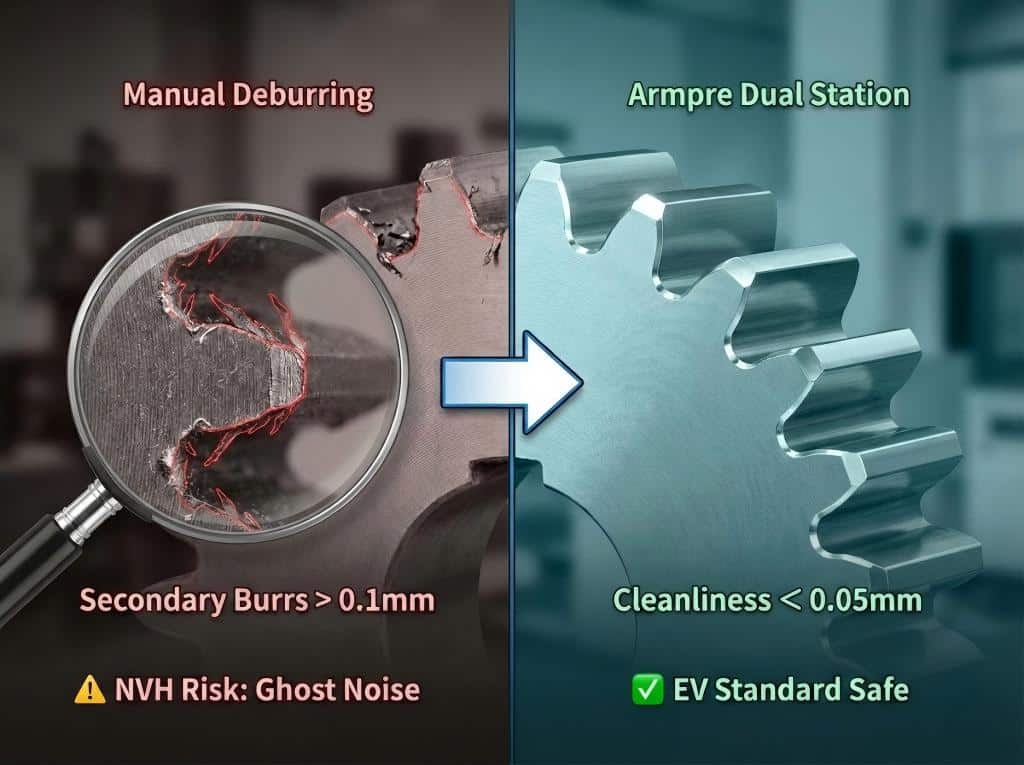
The culprit wasn't the tooth profile. It was a 0.05mm "Secondary Burr" hidden at the root.
In the era of Internal Combustion Engines (ICE), engine roar masked these imperfections. But in the EV era, where the motor is silent, gear chamfering has evolved from a simple "cleaning process" to a critical "Acoustic Engineering" step.
If you are looking for a Gear Chamfering Machine in 2026, you aren't just buying a tool to remove metal; you are buying certainty for your NVH (Noise, Vibration, Harshness) scores. This guide will walk you through the Armpre standard for achieving 100% root cleanliness.
1. The "Invisible" Killer: Secondary Burrs & NVH
Why is "Deburring" no longer enough? Because traditional manual grinding or low-end machines often leave a "folded" piece of metal at the edge—this is the Secondary Burr.
The Armpre Standard for 2026:
-
Physical Requirement: Residual burrs must be strictly < 0.1mm (visual zero).
-
Acoustic Requirement: No "Ghost Noise" under high-speed load.
-
Consistency: 100% pass rate on the profilometer (CMM).
🟨 Tony's Insight
"Field Phenomenon: Many factories still use manual air grinders. My advice: You must introduce automated CNC chamfering or gear chamfering machine. If you face noise rejection issues, this < 0.1mm standard is your lifeline."
2. The Process Logic: Pre vs. Post Heat Treatment
Before buying a machine, you must decide where to place it in your line. This decision affects your tool life and final quality.
-
Pre-Heat Treatment (Soft Machining): The industry "Golden Standard." Armpre machines are typically installed after hobbing but before heat treatment.
-
Why? The material is softer (HRC 20-30), extending tool life significantly.
-
The Logic: Any microscopic residue (< 0.1mm) left by the chamfering machine becomes brittle after heat treatment and is easily blasted away during the Shot Peening process.
-
-
Post-Heat Treatment (Hard Machining): Necessary only for aerospace or high-precision gears that skip final grinding.
🔗 Deep Dive: Not sure which stage fits your line?
[Read: Gear Chamfering Process Guide: Pre vs. Post Heat Treatment Analysis]
3. The Armpre Solution: "Double Insurance" Technology
To meet the strict < 0.1mm requirement for our Korean automotive client, Armpre developed a "Rigid + Flexible" composite process of the gear chamfering machine.
Step A: Rigid CNC Milling (95% Removal)
We use solid carbide inserts with a 5-axis linkage path. This isn't just "cutting"; it's re-profiling the tooth edge to a precise 45° chamfer or R-profile based on DIN/AGMA standards.
Step B: Elastic Brushing (5% Perfection)
This is the secret weapon. An integrated high-speed steel wire brush module performs a second pass. It doesn't cut geometry; it specifically targets the root to "weaken" any secondary burr roots, ensuring they detach instantly during shot peening.
[ 🎬 Video Placeholder: Armpre Milling + Brushing Process ]
🔗 Technology Focus: How does the "Milling + Brushing" combo work?
[Reveal the "Zero Burr" Secret: Rigid Milling + Flexible Brushing Explained]
4. Selection Guide: Fly Cutting vs. Rotary Chamfering
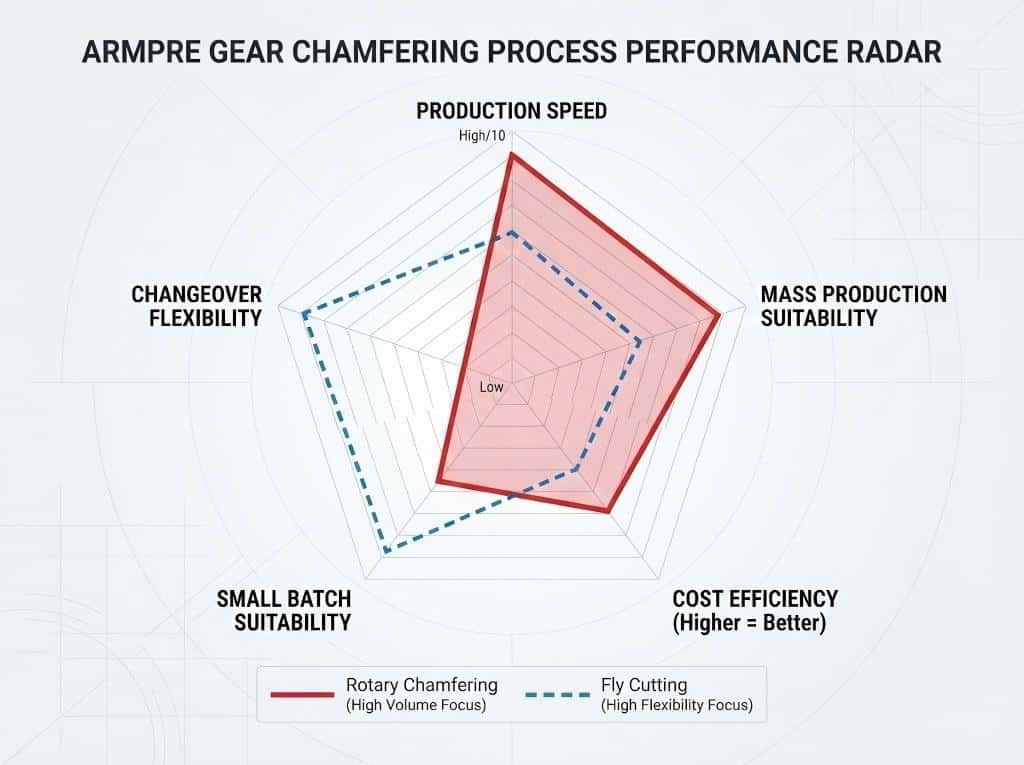
Which technology maximizes your ROI? It depends on your volume and mix. We have compared the two dominant technologies available from Armpre.
| Dimension | Fly Cutting (5-Axis) | Rotary Chamfering (Extrusion) |
|---|---|---|
| Efficiency |
Medium 30-60 sec / part |
Winner Extremely High (5-10 sec / part) |
| Flexibility |
Winner Extremely High (Program Change) |
Low Requires custom wheels |
| Tool Cost |
Low Cost Standard Inserts |
High Cost Custom Rollers |
| Best For |
High-Mix, Job Shops (Prototyping & Small Batches) |
Mass Production (Single Part > 200k/year) |
[Data Source: Armpre Internal Comparison Chart]
To visualize this trade-off, look at the Armpre Performance Radar below:
🟦 Need a Cycle Time Calculation?
Don't guess your ROI. Send us your gear drawing (PDF/DWG), and Tony's team will provide a Free Cycle Time & Tool Life Estimation Report.
5. Beyond the Machine: 24/7 Automation & Capacity
In 2026, labor costs are rising. The best machine is one that doesn't need a babysitter. Armpre machines come ready for Industry 4.0 integration.
-
Standardized Interfaces: I/O and Profinet protocols for seamless robot handshakes.
-
Auto-Door Logic: Pneumatic doors synchronized with loading arms.
-
Capacity: Armpre’s ISO 9001 facility produces 50+ sets per month, ensuring we can meet rapid deployment needs for global automotive plants.
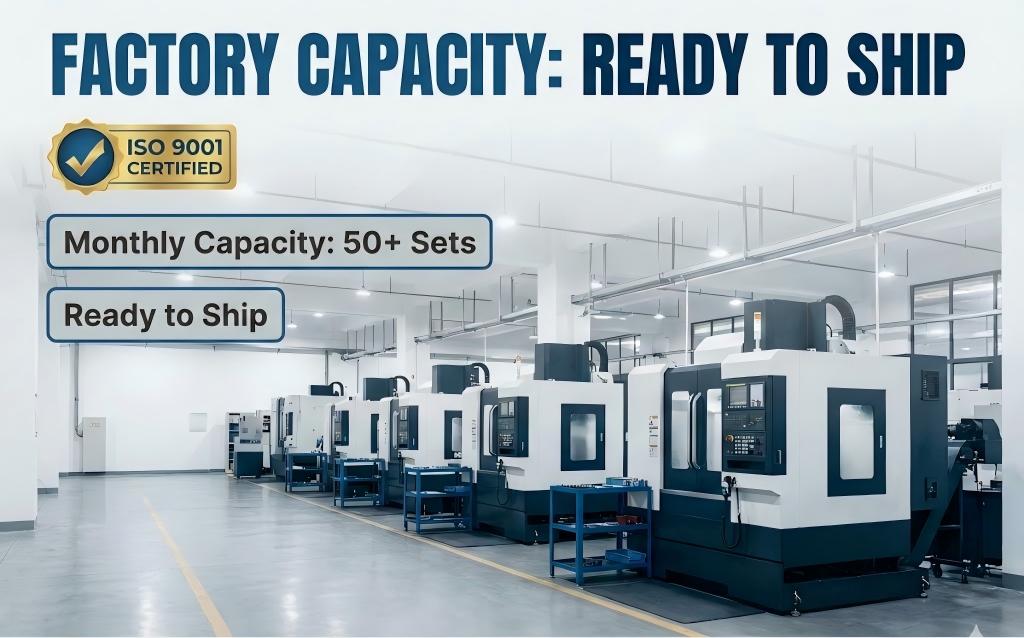
Figure 3: Direct Factory Supply. Armpre maintains a monthly capacity of 50+ sets for rapid deployment.
🔗 Future Proofing:
[Case Study: How Robot Integration Boosted Delivery Speed by 20%]
6. The Top 5 "Whys" from Procurement (FAQ)
We recommend "Milling + Brushing". By precisely controlling the cutting path and using the secondary brush module, residue is stably controlled within 0.1mm.
Absolutely not. Armpre machines use Conversational HMI. Operators simply input Module, Teeth, and Angle—no complex G-code required.
It depends on the strategy. Using Standard Carbide Inserts keeps costs low ($0.02-$0.05 per part) compared to custom tooling.
Versatility is key. Armpre equipment supports Module 1 to 16mm, allowing for physical changeovers between different models within 30 minutes.
We don't just sell machines; we sell uptime. Our remote video verification and "try-out" machining services ensure you see the result before you buy.
Conclusion: Buying Certainty
We are choosing a silence guarantee for every gear,
and the composure to face the rigorous quality inspections of 2026."