
Choosing the Right Gear Chamfering Machine: The Ultimate Guide for High-Precision Automotive Manufacturing (2026 Edition)
From "Deburring" to "Acoustic Engineering": How to Eliminate Secondary Burrs & Silence EV Whine.
Author: Tony, Senior CNC Consultant
Updated: Jan 29, 2026
Reading Time: 8 Minutes

Figure 1: The 2026 Standard: A dual-spindle chamfering station designed for 100% burr removal in high-speed EV gears.
👋 Opener: When 18,000 RPM Meets a Micron-Level Burr
I still remember being on the floor of an EV transmission plant in Detroit last month. As the test bench motor ramped up to 18,000 RPM, that maddening "whine" pierced through the room.
It wasn't because the gear profile was ground incorrectly. It was because of a "secondary burr" barely visible to the naked eye. In the Internal Combustion Engine (ICE) era, the roar of the engine was a shield that masked these imperfections. But in the 2026 EV era, this micron-level metal flap is the culprit that destroys the acoustic score of the entire vehicle.
📽️ Video Description: > [Image of high speed gear chamfering process close up]
Imagine a slow-motion macro shot: The moment the chamfering tool touches the gear edge, there are no sparks, no violent vibrations. The cutter glides across the steel like a knife through hot butter, leaving a perfect 45-degree bevel while coolant washes away the heat. This is the art of "Cold Machining."
📊 The 2026 Selection Rule > The core of selecting a gear chamfering machine in 2026 is not just "deburring," but "re-shaping tooth geometry." A qualified machine must maintain chamfer consistency in mass production, keep secondary burrs strictly < 0.1mm, and fully meet the precision positioning requirements for DIN 4 gear grinding (refer to AGMA Standards for tolerance comparisons).
[YouTube Video Placeholder: High-Speed Gear Chamfering Process for EV Gears]
1. Why Has "Chamfering" Become the Life-or-Death Line for NVH?
The transition from ICE to EV is not just a change in power; it is a reconstruction of acoustic standards.
Previously, the broadband noise of an engine covered up minor meshing flaws. But since electric motors are silent, any irregular protrusion (burr) or inconsistent chamfer angle on the gear edge transforms into a piercing high-frequency whine during high-speed meshing.
💡 Tony's Insight > * Field Phenomenon: Many factories still use manual air grinders or machines that leave sharp edges at the root.
- Technical Analysis: Manual processing results in a Cpk < 1.0 and cannot create a smooth Chamfer Rolling curve.
- My Advice: You must introduce automated chamfering processes to eliminate human uncertainty.
- If you are facing noise rejection issues, I suggest reading my deep dive on How Proper Gear Chamfering Eliminates NVH Issues in EV Drivetrains.
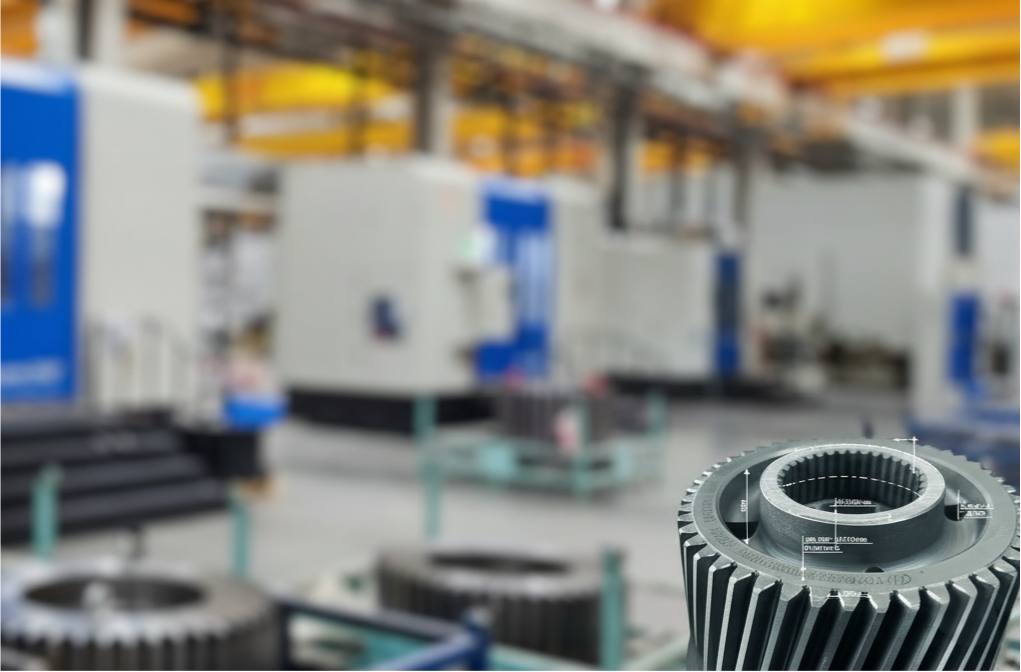
Figure 2: The "Silence" Difference: Achieving 0.01mm accuracy and eliminating secondary burrs instantly to prevent transmission whine.
2. Process Showdown: Fly Cutting vs. Rotary Chamfering
Selection isn't about buying the most expensive machine; it's about matching capacity. This is the part Procurement Managers struggle with most.
🚦 Scenario Exclusion Logic > If your production line is High-Mix, Low-Volume (e.g., Construction Machinery gears or Job Shop work), Then I absolutely do NOT recommend expensive, dedicated Rotary/Extrusion Chamfering machines. The high tooling costs and long changeover times will eat your profits. In this case, flexible 5-Axis Fly Cutting is the correct answer.
To help you calculate the math, I have compiled a comparison guide: Rotary Chamfering vs. Fly Cutting: Which Method Suits Your Production Volume?.
| Dimension | Fly Cutting (5-Axis) | Rotary Chamfering (Extrusion) |
|---|---|---|
| Efficiency |
Medium 30-60 sec / part |
Winner Extremely High (5-10 sec / part) |
| Flexibility |
Winner Extremely High (Program Change) |
Low Requires custom wheels & tooling change |
| Tool Cost |
Low Cost Uses Standard Inserts ($) |
High Cost Requires Custom Rollers ($$$) |
| Best For |
High-Mix, Job Shops (Prototyping & Small Batches) |
Mass Production (Single Part > 200k/year) |
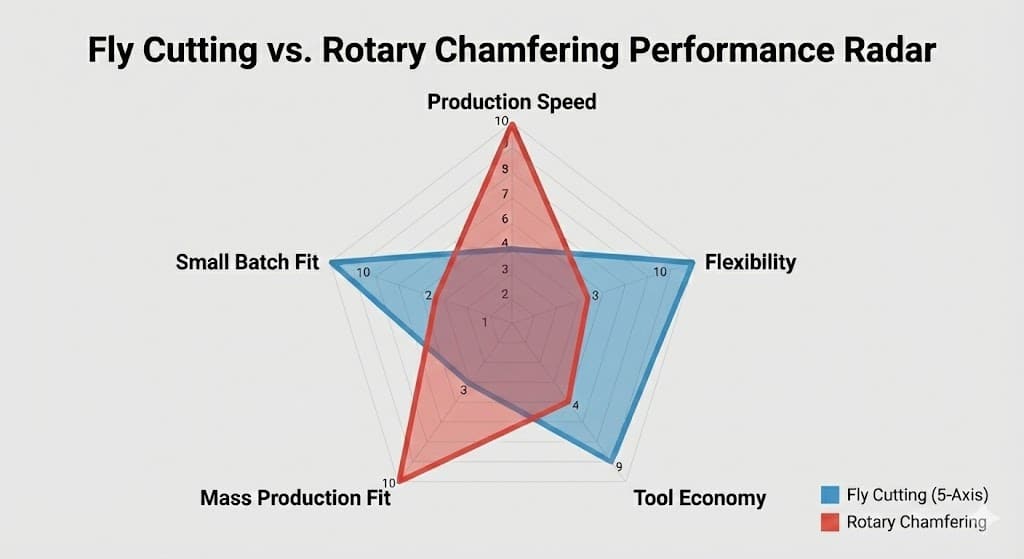
Figure 3: The Performance Radar: Visualising the trade-off. Fly Cutting (Blue) dominates high-mix scenarios, while Rotary Chamfering (Red) is the king of mass production efficiency.
3. 2026 Flagship Model Analysis & Parameter Traps
Based on my 20 years of installation experience, I don't look at ads; I look at shop floor performance. We define the coordinate system for a top-tier 2026 chamfering machine using four dimensions: Structural Thermal Stability, Dry Cutting Capability, Secondary Burr Control (<0.1mm), and Digital Interfaces (OPC UA).
Brand Tier Analysis
- Tier 1 (Extreme Precision / Euro-American): Gleason (300CD), Liebherr, Klingelnberg. These are the industry benchmarks, emphasising linkage precision with gear grinding machines. Ideal for OEMs with ample budgets chasing ultimate NVH.
- Tier 2 (High ROI / Flexible): Armpre, Kashifuji, Qinchuan, Seiwa. This tier is the first choice for Job Shops. Armpre, in particular, stands out by optimising changeover flexibility while maintaining high rigidity, making it perfect for multi-variety production lines.
- Speciality (Niche): Rausch, Tecnomacchine. Experts focused purely on deburring solutions.
⚠️ The Comparison Trap > Don't be fooled by "Max RPM." Some machine spindles spin fast but lack rigidity. Once you cut hardened gears (>HRC 55), tool life will drop off a cliff.
Which machine fits your prints? Click here to get a Free Cycle Time Estimation Report—we'll run the data for you.
4. Hidden Costs: The Tools and Fixtures Eating Your Profit
The machine is a one-time investment (Capex), but tooling is a continuous bleed (Opex).
📏 The Metric (Quantitative Standard) > Under 2026 standards, the Tool Cost Per Part should be controlled between $0.02 - $0.05. If your cost exceeds this red line, your process has a problem (usually vibration or thermal shock).
Often, short tool life isn't the tool's fault—it's the fixture rigidity. Details can be found in my technical review: Hidden Factors Affecting Tool Life in High-Speed Gear Chamfering Operations.
[Image of Comparison of worn vs new carbide chamfering inserts under microscope]
Figure 2: Micro-chipping on the edge (left) is a sign of vibration, not normal wear.
5. The Top 5 "Whys" from Procurement (FAQ)
We recommend "Milling instead of Grinding". By precisely controlling the cutting path and using high-quality carbide, secondary burr residue is stably controlled within 0.1mm or removed entirely, unlike messy grinding wheels.
Absolutely not. 2026 machines reject complex G-code. Equipment like Armpre integrates Conversational HMI Interfaces. Operators simply input the Module, Teeth, and Angle, and the system generates the tool path automatically.
Even the best machine fears downtime. Ensure your supplier has a Technical Service Network in major markets (EU/NA) for 24h spare parts response. We don't just sell machines; we sell uptime.
Versatility is key for Job Shops. Selecting equipment that supports Module 1 to 16mm is crucial. Premium equipment allows for physical changeovers between different models within 30 minutes.
It depends on the consumable strategy. I recommend using Standard Carbide Inserts instead of expensive custom wheels to keep costs low ($0.02-$0.05 per part). Avoid machines that lock you into proprietary tooling.
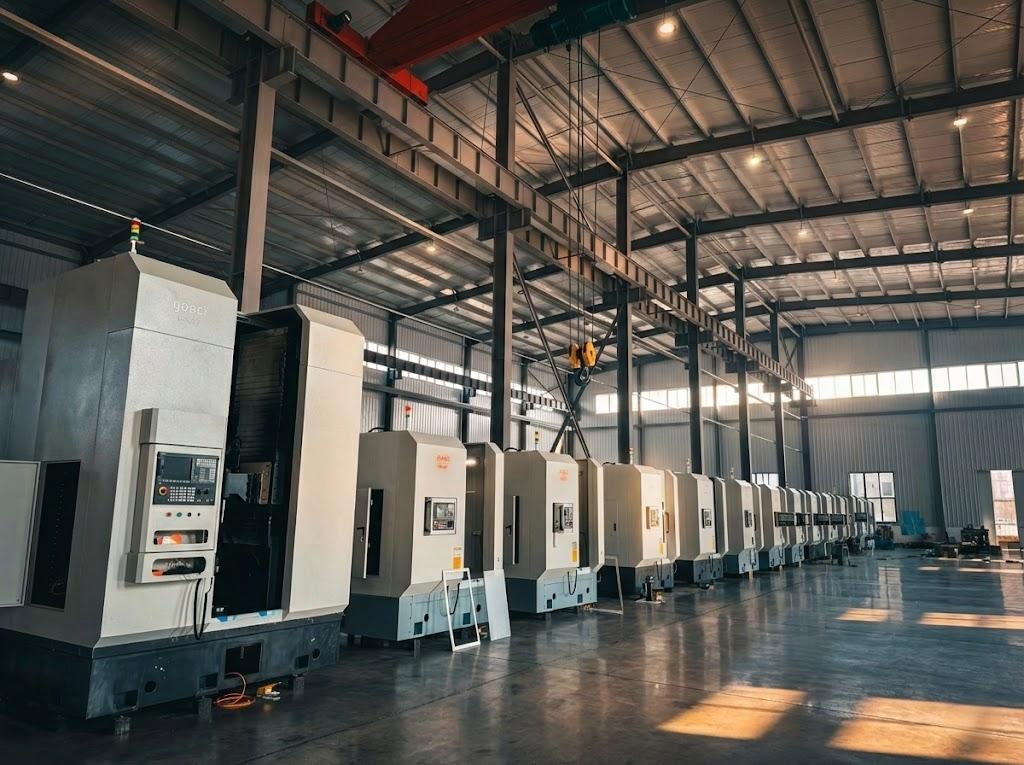
Figure 4: Direct Factory Supply: We maintain a monthly capacity of 50+ sets to ensure rapid deployment for your production line.
Conclusion: Buying Certainty
We are choosing a silence guarantee for every gear,
a stable output for every second on the line,
and the composure to face the rigorous quality inspections of 2026."
Get a custom ROI analysis based on your drawings.