
ACME Thread Size Chart: General Purpose (GP) Dimensions & Tolerances

"Welcome to Armpre Manufacturing's definitive ACME Thread Size Chart for General Purpose (GP) applications. ACME threads, characterized by their robust 29-degree thread angle and flat crests/roots, are indispensable in transmitting power and motion across various industries, from lead screws to heavy-duty vises. This comprehensive guide provides essential dimensions, including major diameter, pitch, and lead, conforming to the ASME B1.5 standard. Engineers and machinists can utilize this data to ensure precise design, machining, and inspection of ACME threaded components, ensuring optimal performance and durability."
1. What is ACME/ANSI B1.5 for bolts?
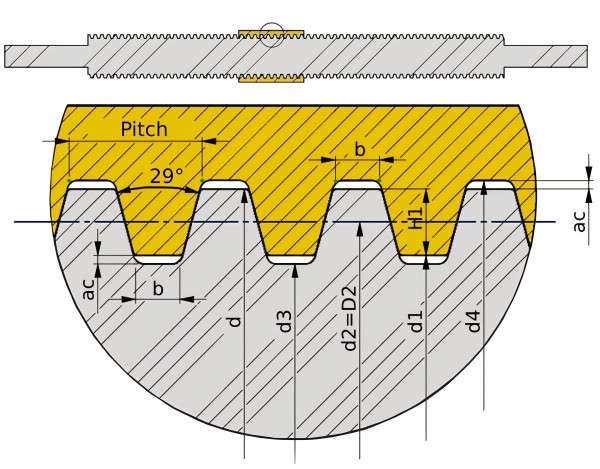
The ANSI/ACME B1.5 ACME Screw Threads Standard provides
- General Purpose ACME, and
- Centralizing ACME
What is Acme? What is the acme thread standard? Centralizing Acme threads have limited clearance at the major workpiece diameters of both the internal and external threads and are widely used extensively for feeding screws. screw rod, Restricted clearance enables a bearing at the major diameter of the thread to preserve alignment of the threading axis, preventing part sagging.
2. What is Types of Acme Threads
Acme screw threads fall into three categories, summarized in the table below
| Type | Specifications |
|---|---|
| General Purpose (G) | Most commonly used Acme threads with minimal backlash in 3D and 4G class. |
| Centralizing (C) | Compararively more accurate and have less backlash due to tight clearance. |
| Stub Acme | Compact threads with a 43% shorter stub height than standard Acme |
3. What is ACME Thread General Purpose Size Chart
The following chart size defines indusctry standard sizes for External ACME General Purpose Threads
per American National Standard ASME/ANSI B1.5
acme thread angle is 29° while trapezoidal metric thread thread angle is 30
| Nominal Size (in) | Threads Per Inch (TPI) | Pitch (P) (in) | Major Dia. (D) (in) | Minor Dia. (d) (in) | Pitch Dia. (PD) (in) | Lead (L) (in) |
|---|---|---|---|---|---|---|
| 1/4 | 16 | 0.0625 | 0.250 | 0.146 | 0.198 | 0.0625 |
| 3/8 | 12 | 0.0833 | 0.375 | 0.242 | 0.308 | 0.0833 |
| 1/2 | 10 | 0.1000 | 0.500 | 0.350 | 0.425 | 0.1000 |
| 5/8 | 8 | 0.1250 | 0.625 | 0.458 | 0.541 | 0.1250 |
| 3/4 | 6 | 0.1667 | 0.750 | 0.550 | 0.650 | 0.1667 |
| 7/8 | 6 | 0.1667 | 0.875 | 0.675 | 0.775 | 0.1667 |
| 1 | 5 | 0.2000 | 1.000 | 0.780 | 0.890 | 0.2000 |
| 1 1/4 | 5 | 0.2000 | 1.250 | 1.030 | 1.140 | 0.2000 |
| 1 1/2 | 4 | 0.2500 | 1.500 | 1.250 | 1.375 | 0.2500 |
| 1 3/4 | 4 | 0.2500 | 1.750 | 1.500 | 1.625 | 0.2500 |
| 2 | 4 | 0.2500 | 2.000 | 1.750 | 1.875 | 0.2500 |
Note: All dimensions are in inches and conform to ASME B1.5 for General Purpose (GP) ACME Screw Threads. For multiple lead or stub ACME threads, consult specific application standards.
For full technical specifications and tolerance classes, refer to the official ASME B1.5 Standard.
5.Industrial Applications of ACME Threads
The unique 29° trapezoidal profile makes ACME threads the premier choice for high-load power transmission and precision linear motion control across multiple industries.
Lead & Jack Screws
Essential for heavy-duty lifting equipment, CNC linear actuators, and high-capacity industrial jacks requiring reliable motion.
Vises & Clamping
The standard for professional bench vises and heavy-duty industrial clamps where high torque and clamping force are paramount.
Industrial Valves
Integrated into gate and globe valve stems to provide robust mechanical control over fluid flow in high-pressure environments.
Aerospace Actuators
Utilized in mission-critical flap and slat actuators where mechanical integrity under extreme stress is non-negotiable.
6. Conclusion Advantages of Using Acme Threads
For this post, you can see 'what is Acme ', 'the acme thread size', and 'what is the acme thread standard'. Acme threads are mostly associated with the lead screws machine industry.
When compared to other threads, Acme threads present far superior wear properties, load capabilities, and tolerances than any standard threaded rods.
with lower operating, manufacturing, and maintenance costs than the ball screw for the same industry application (where linear motion is necessary).
Acme threads are also ideal for vertical, light/moderate loading conditions and offer very much safer holding condition when operating under static load.
Our Armpro Threadd rolling machine can do ACME Thread with high efficiency, and will become your reliable partner.
pls contact us for more details
What is the primary difference between General Purpose (GP) and Centralizing (C) ACME threads?
General Purpose (GP) ACME threads, specified by ASME B1.5, are designed primarily for transmitting power and motion. Centralizing (C) ACME threads (ASME B1.8) have tighter tolerances on the major diameter and root to ensure better alignment and prevent wedging in applications where a follower nut needs to be precisely guided, such as in precision lead screws.
Why are ACME threads preferred over square threads for power transmission?
ACME threads, with their 29-degree flank angle, are easier to manufacture than square threads, as they don't require the cutting tool to exactly match the root radius. This angled design also allows for the use of split nuts (like bronze nuts in lead screws) to compensate for wear, which is difficult with square threads. The angle also provides greater thread strength compared to the purely radial load bearing of square threads.
What are the key dimensions an engineer needs for ACME thread design?
The most critical dimensions for ACME thread design are the Nominal Size, Threads Per Inch (TPI) or Pitch (P), the Major Diameter (D), Minor Diameter (d), and especially the Pitch Diameter (PD). For power transmission, understanding the Lead (L) is crucial, particularly for multiple-start threads, as it dictates the axial travel per revolution.
Ultimate Thread Comparison Cheat Sheet
Identify Metric, UNF, BSPP, and NPT threads in seconds. A must-have 1-page PDF guide for engineers and machinists.
Thread Standard Technical Resources
International standard M-series specifications, including coarse and fine pitch data.
Unified StandardUnified Fine thread dimensions for high-precision fasteners and aerospace applications.
American StandardTapered pipe thread reference for leak-free seals in fluid and gas systems.