
ISO Metric (M) Thread Size Chart & Manufacturing Guide
Global ISO Metric Thread Catalog: Coarse & Fine Pitch Specifications (M1 - M64)
International Standard
The specifications on this page are compiled in accordance with
ISO 68-1
and ISO 261. These metric M-series threads feature a universal 60° profile and are the primary standard for mechanical fasteners worldwide, ensuring full interchangeability across global manufacturing sectors.

Understanding ISO Metric Threads (M-Series)
ISO Metric threads are the global standard for general-purpose screw threads, defined by the ISO 261 and ISO 965 standards. As the most widely used thread system in mechanical engineering, the "M" series (e.g., M6, M8, M10) is designed for high-strength fastening and interchangeability across international manufacturing sectors.
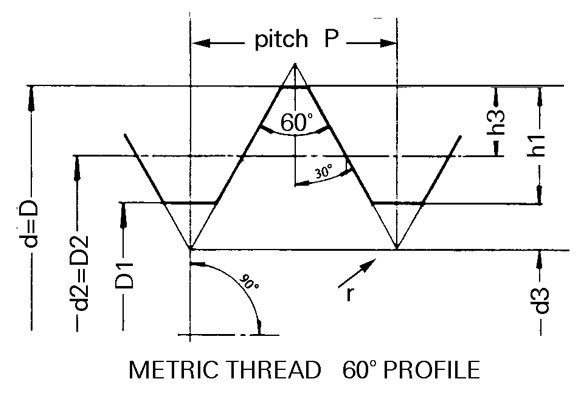
The Metric thread profile features a 60° symmetrical V-shape, where the pitch ($P$) is defined as the distance between thread crests in millimeters. Unlike tapered pipe threads, Metric threads are parallel (cylindrical), meaning they do not create a seal through thread interference alone. In fluid power or pressurized applications, Metric threads rely on mechanical compression—typically utilizing a copper washer, O-ring, or a bonded seal (Dowty seal) against a flat mating surface to ensure a leak-proof connection.
Quick Navigation: What You Will Learn
-
Metric Thread Size Chart: Complete dimensions for M1 to M68 (Coarse & Fine pitch).
-
Thread Pitch Explained: How to correctly identify Metric pitch ($P$) vs. Imperial TPI.
-
Sealing Methods: Best practices for O-ring and bonded seal (Dowty) applications.
-
Drill & Tap Sizes: Recommended hole sizes for internal thread tapping.
-
Free Engineering PDF: Download the master thread comparison chart for your workshop.
1. What is the ISO Metric Thread parameter?
ISO metric threads are a standardized measuring system used to measure and specify threaded fasteners like bolts and nuts. There are several parameters that can be found in the ISO metric threads.
These parameters ensure that high compatibility and interchangeability of threaded components are achieved by providing a comprehensive specification for metric threads.
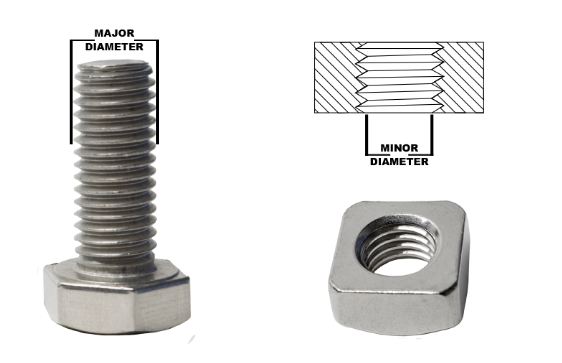
- Thread Pitch (P): The distance between adjacent threads along the fastener's axis is the thread pitch.
- Major Diameter (D): The outer diameter of the threaded part of the fastener.
- Minor diameter (d): The diameter at the bottom of the thread's grooves is the minor diameter.
- Pitch diameter (d2): It is a theoretical diameter which lies between the major and minor diameters. This parameter is used for various calculations and imperative in ensuring the proper engagement of the thread.
- Thread angle: The ISO metric thread standard has a thread angle of 60-degrees which is a common system in many threads.
- Thread tolerance: ISO metric threads possess predefined tolerances for major and minor diameters and the diameter of the pitch. These tolerances enable to make sure that threads may fit together correctly even if they are from different manufacturers.
- Thread series: ISO metric threads are produced in several series which includes the coarse thread series that is designated as 'M' and the fine thread series that is designated as 'MF'.
These parameters are considered essential in various industries where threaded fasteners have wide applications like automotive to construction.
2. What is the ISO Metric Thread size chart
Metric Coarse vs. Metric Fine Threads: What’s the Difference?
When specifying ISO Metric threads, Selecting the correct one is critical for joint integrity—learn more in our comprehensive [Coarse vs. Fine Threads Comparison]. While Coarse threads are the industry default, Fine threads offer distinct advantages in precision applications.
1. Metric Coarse Threads (Standard)
Metric Coarse threads (e.g., M10 x 1.5) are the most common type used in general engineering and commercial fasteners.
-
Pros: Faster assembly, less prone to cross-threading, and higher resistance to stripping in softer materials.
-
Best For: General construction, heavy-duty machinery, and applications where rapid assembly is required.
2. Metric Fine Threads
Metric Fine threads (e.g., M10 x 1.25 or M10 x 1.0) have a smaller lead angle and more threads per axial distance.
-
Pros:
-
Higher Strength: Due to a larger minor diameter, fine-thread bolts have a larger cross-sectional area, increasing tensile strength.
-
Vibration Resistance: The shallower thread angle provides better friction, preventing the bolt from loosening under vibration.
-
Precision Adjustment: Ideal for applications requiring fine-tuned tension or positioning.
-
-
Best For: Automotive engines, aerospace components, and thin-walled tubes where deep coarse threads would weaken the material.
Expert Tip: Always verify the pitch before ordering. Using a Coarse bolt in a Fine-threaded hole will cause immediate and permanent thread galling.
| Thread (M) | Major Dia. (mm) | Pitch (mm) | Tap Drill (mm) | Inquiry |
|---|---|---|---|---|
| M20 ★ | 20.00 | 2.50 | 17.50 | Get Quote |
| M22 | 22.00 | 2.50 | 19.50 | Inquiry |
| M24 ★ | 24.00 | 3.00 | 21.00 | Get Quote |
| M27 | 27.00 | 3.00 | 24.00 | Inquiry |
| M30 ★ | 30.00 | 3.50 | 26.50 | Get Quote |
| M33 | 33.00 | 3.50 | 29.50 | Inquiry |
| M36 ★ | 36.00 | 4.00 | 32.00 | Get Quote |
| M39 | 39.00 | 4.00 | 35.00 | Inquiry |
| M42 ★ | 42.00 | 4.50 | 37.50 | Get Quote |
| M45 | 45.00 | 4.50 | 40.50 | Inquiry |
| M48 ★ | 48.00 | 5.00 | 43.00 | Get Quote |
| M52 | 52.00 | 5.00 | 47.00 | Inquiry |
| M56 ★ | 56.00 | 5.50 | 50.50 | Get Quote |
| M60 | 60.00 | 5.50 | 54.50 | Inquiry |
| M64 ★ | 64.00 | 6.00 | 58.00 | Get Quote |
| M68 | 68.00 | 6.00 | 62.00 | Inquiry |
Note: The sizes listed above are ISO Metric Coarse (ISO 261). Major Diameter and Tap Drill sizes are provided for reference in manufacturing and sourcing.
The ISO metric thread size chart is a standard table that provides a standardized reference for the specification of metric threads, including the major diameter (D), pitch (P), and thread designation. Below is a version of the standard size chart for ISO metric threads.
The above chart shows the standard specifications for ISO metric threads. include Coarser and fine threads, Based on your requirements you can go through the size chart to choose the most suitable ISO metric thread to suit your needs and requirements.
3. What is the application of the ISO Metric Thread?
ISO Metric threads have a large range of applications across various industries around the world. This is due to their standardized design and size. Some such industries where ISO metric threads are used are given below.
| 1. Manufacturing and engineering industry |
| ISO metric threads are very often used in the manufacturing and engineering industry for the manufacturing of machinery, components, and equipment. They are used mostly as they provide a standardized way to connect and secure parts of the machinery, thereby ensuring interchangeability and compatibility. |
| 2. Construction industry |
| ISO metric threads are used in the construction industry to assemble structural components, securing the scaffolding, and fastening various materials of buildings. |
| 3. Aerospace industry |
| Aerospace engineering highly relies on precision. metric threads are considered very suitable for assembling aircraft components, securing critical systems and ensuring the integrity of the aircraft considering its structure. |
| 4. Automotive industry |
| ISO metric threads are very commonly used in automobiles. They are used to secure various components including engine parts, fasteners and chassis components. |
| 5. Electronics industry |
| Metric threads are used in the electronics industry to secure devices, enclosures and assemblies thereby ensuring proper alignment and electrical connections. |
| 6. Medical devices manufacturing industry |
| ISO metric threads are used in the manufacturing of medical devices. Metric threads ensure the proper assembly and function of various instruments and equipment. |
| 7. Plumbing and pipe fittings manufacturing industry |
| ISO metric threads are used in the manufacturing of plumbing and fluid systems in order to connect pipes, valves, and fittings. This also ensures a leak-tight seal. |
| 8. Fasteners manufacturing industry |
| Metric bolts, screws, and nuts equipped with ISO metric threads are available for general purpose use and are commonly found in almost all hardware stores. |
| 9. Bicycles and sports equipment |
| ISO metric threads are used in the assembly of bicycles, sporting equipment and outdoor gear in order to ensure that the equipment has the highest stability and safety. |
| 10. Furniture equipment manufacturing industry |
| ISO metric threads are used in the assembly of furniture, home appliances, consumer goods and other household products. Using metric threads to manufacture these products makes it easier to assemble and disassemble these products. |
4. How to make an ISO Metric Thread?
Creating ISO metric threads require high knowledge of precision, especially if the threads are to be used for critical applications. Using the correct tap or die sizes and lubricating the threading tool is very important in order to achieve accurate and well-formed threads. Their specifications must be carefully crafted as they are itself used to give high-precision solutions.
ISO metric threads consist of a symmetrical V-shaped thread, where the V has an angle of 60° in the plane of the thread axis. The depth of the thread id about 0.54125 x pitch and the outermost ⅛ and the innermost ¼ of the height are cut off from the profile of the V-shape.
If you are working with American machinery, you may also need our UNF/UNC Thread Size Chart for cross-reference.
For heavy-duty power transmission that exceeds standard Metric capabilities, consider the ACME General Purpose Thread
5. Conclusion
In conclusion, ISO metric threads serve as the sole language of precision engineering. They provide a standardized system for measuring the thread and specifications. The ability to apply them in a wide range of applications in various industries, from aerospace to construction and electronics.
The ISO metric threads standard ensures that the products contain compatibility and interchangeability. Moreover, they contribute to the safety, quality and reliability of the products and machinery that are distributed worldwide. The simplicity and the precision of ISO metric threads make it an invaluable tool for engineers, manufacturers, constructors, and designers, as they simplify the complexities of threaded fasteners.
With the advancement and globalization that the industries are undergoing currently, ISO metric threads remain a solid ground for efficient production, maintenance, and repair. Therefore, whether you are planning to build a skyscraper, assemble an engine for the latest model of a car, or even in the middle of the process of designing the latest technological innovation, ISO metric threads will continue to have a vital role in shaping the future of the whole world.
Ultimate Thread Comparison Cheat Sheet
Identify Metric, UNF, BSPP, and NPT threads in seconds. A must-have 1-page PDF guide for engineers and machinists.
Thread Standard Technical Resources
G-series parallel threads dimensions, pitch, and major diameters.
American StandardTapered pipe thread standards for secure, pressure-tight seals.
Unified StandardFine thread specifications for hydraulic and precision fasteners.