
UNF (Unified National Fine) Thread Size & Dimensions Chart
UNF Thread Identification Guide: Fine-Pitch Standards for High-Performance Fastening
Technical Compliance
All UNF (Unified National Fine) dimensions and tolerances provided on this page are strictly based on the
ASME B1.1-2024
standard. These fine-pitch threads are engineered for high-tensile strength and precision fastening in aerospace and automotive applications.

UTS (Unified Thread Standard) is a standard used around the United States and Canada that is used as an identification standard for screws, bolts, and nuts. As there are a number of different types of threads, the UTS standard was developed in order to be used as a specific standard to differentiate among the various types of threads. Different types and series of screw threads belong to this standard.
They are UNC (Unified National Coarse Threads), UNF (Unified National Fine Threads), UNEF (United National Extra Fine Pitch Threads) and UNS (Unified Special Threads. These standards are applied based on the specific screws, bolts and nuts.
The UNF and UNC are defined based on the number of threads per inch (TPI). while both types are generally used for fastening they are applied in different fields as their varying characteristics provide differentiated facilities.
For instance, due to the higher strength possessed by the UNC thread, they are used in applications that require high tensile strength. Meanwhile, UNF threads are used for sealing due to their reliable self-sealing structure.
1. What is Characteristics of UNF - Unified National Fine Threads
UNF threads, unlike UNC threads, have a finer pitch. These types of threads are used in applications which require high tensile strength and in applications where the threaded parts are relatively thin. Some similarities can be found between UNC and UNF threads. Both UNC and UNF threads in male and female versions are parallel to each other. Also, the flank angles of both UNC and UNF threads are 60 degrees. The typical designation of a UNF thread is ½” x 20. The standard of UNF threads is managed by the ANSI/ASME B1.1 Unified National Thread.
The UNF thread has a smaller space occupation size and better self-locking performance when compared to a UNC thread. A number of different fine thread types can be found to make a series of fine threads - MF/UNF/UNRF. these fine threads are not generally used in applications which require a large stress. Usually, fine threads are used in applications like positioning and fixing adjustments, and similar instances where high fastener strength is required. Also, fine threads are used in applications where fine adjustments are done. for instance, these threads are used in tools like micrometers and to fix lenses in various optical instruments, and battery covers of metal-shelled flashlights.
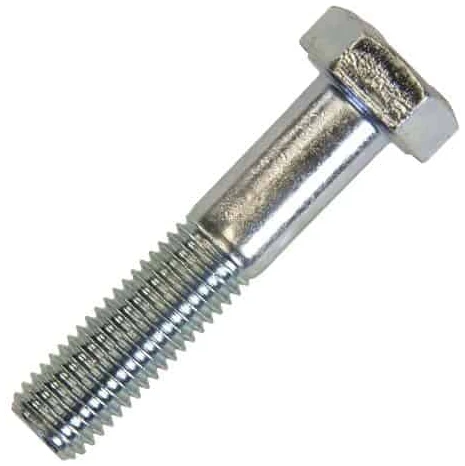
Although with its specified advantages, has its disadvantages too. As the fine thread is comparatively smaller in height and size, it can be prone to displacement and disorder very easily. Also, it should be regularly cleaned up as the burr is important during assembly. moreover, it can be difficult to remove the threads in case of any emergency, due to their small size.
UNF threads have a smaller pitch and consist of more teeth screwed in the same thread length. This feature is important as it can prevent fluid leakage, and is made use of in applications where sealing is needed. As UNF threads have a smaller cross-section size of each tooth, with a large number of teeth, they are generally replaced with UNC threads for applications that require bearing a large tensile force and impact force. However, compared to the UNF threads, UNC threads have a batter interchangeability and higher measure of strength, while also possessing greater tolerances and thereby handling manufacturing in a better way than UNF threads.
However, based on their different characteristics, both UNC and UNF threads have different uses and are applied in a wide range of applications.
2. What is the Key Applications of UNF threads
Key Applications of UNF Threads
While UNC (Coarse) and UNF (Fine) threads often achieve similar functional outcomes, UNF threads offer superior prevention of loosening. Due to their smaller helix angle, fine threads possess an enhanced self-locking feature, ensuring the connection remains tight under stress.
Core Advantage: UNF threads are the preferred choice for thin-walled parts and environments requiring high anti-vibration capabilities.
The specialized structure of Unified Fine threads makes them indispensable across various high-precision industries:
- ✔ Hydraulic & Pneumatic Systems
- ✔ Aerospace & Automotive Industry
- ✔ Medical Device Manufacturing
- ✔ Telecommunications Industry
- ✔ High-Performance Machinery
- ✔ Precision Control Systems
Pro Tip: In specific high-vibration applications, UNF threads provide significantly better reliability than standard coarse threads.
3. What is the size chart for UNF - Unified National Fine Threads ?
| Size Designation | TPI (Threads Per Inch) | Major Diameter (inch) | Major Diameter (mm) | Tap Drill Size |
|---|---|---|---|---|
| #0 - 80 UNF | 80 | 0.0600 | 1.524 | 3/64" (#53) |
| #4 - 48 UNF | 48 | 0.1120 | 2.845 | #42 |
| 1/4" - 28 UNF ★ | 28 | 0.2500 | 6.350 | #3 (0.213") |
| 5/16" - 24 UNF | 24 | 0.3125 | 7.938 | I (0.272") |
| 3/8" - 24 UNF ★ | 24 | 0.3750 | 9.525 | Q (0.332") |
| 7/16" - 20 UNF | 20 | 0.4375 | 11.113 | 25/64" |
| 1/2" - 20 UNF ★ | 20 | 0.5000 | 12.700 | 29/64" |
| 9/16" - 18 UNF | 18 | 0.5625 | 14.288 | 33/64" |
| 5/8" - 18 UNF | 18 | 0.6250 | 15.875 | 37/64" |
| 3/4" - 16 UNF | 16 | 0.7500 | 19.050 | 11/16" |
| 7/8" - 14 UNF | 14 | 0.8750 | 22.225 | 13/16" |
| 1" - 12 UNF | 12 | 1.0000 | 25.400 | 59/64" |
| 1-1/4" - 12 UNF | 12 | 1.2500 | 31.750 | 1-11/64" |
| 1-1/2" - 12 UNF | 12 | 1.5000 | 38.100 | 1-27/64" |
* Dimensions are based on ASME B1.1 standards for Unified Fine threads. ★ indicates most common sizes for high-tensile fasteners.
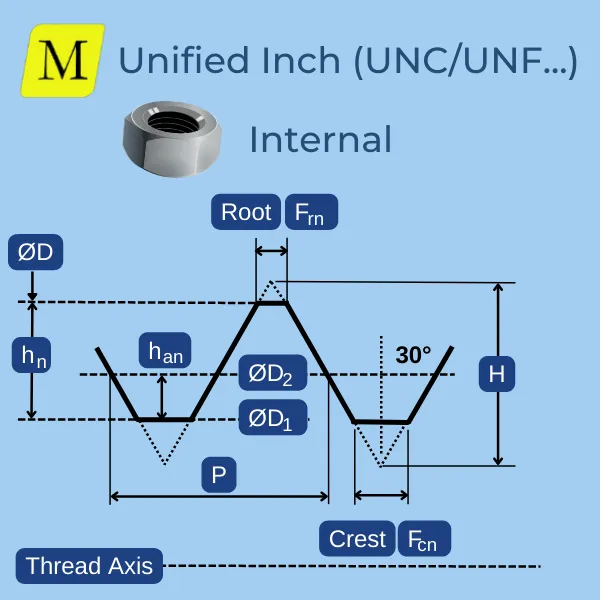
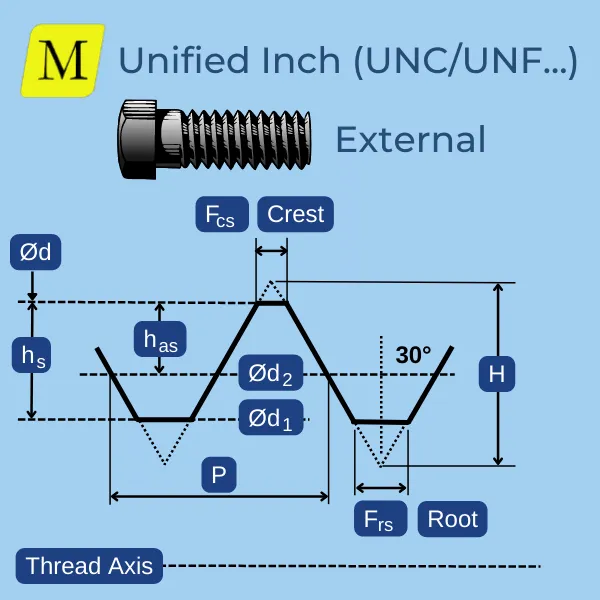
The following table offers a quick guide on the available UNF thread sizes where you can refer to the metric thread dimensions and specifications to determine the required UNF thread.
The table below shows the types of screw threads, sizes, and specifications of Unified Fine (UNF) threads.
4. Conclusion
Conclusion: Choosing the Right Unified Thread
The Unified Thread Standard (UTS) is essential for maintaining the reliability and consistency of nuts, bolts, and fittings. Widely used across the United States and Canada, standards like UNC, UNF, and UNEF provide the structural integrity required for modern engineering.
While both Coarse (UNC) and Fine (UNF) threads are indispensable, the UNF series stands out for its specialized structure. With a finer pitch than the coarse series, UNF threads are the primary choice for hydraulic systems, pneumatic systems, medical devices, and the automotive industry—where precision and safety are non-negotiable.
Need Specific Dimensions?
Due to their self-locking efficiency and superior vibration resistance, selecting the exact size is critical for high-performance fastening.
📂 View UNF Thread Size ChartFinal Thought: As engineering requirements vary, always consult a comprehensive UNF thread size chart to ensure you choose the most suitable thread for your specific high-stress or precision application.
The Unified Thread Standard is a standardization developed in order to maintain the reliability and consistency in nuts and bolts used for fastening and other fittings. Many thread series are categorised under the UTS standard and are widely used around United States and Canada. UNC, UNF and UNEF are some such common standards.
Although both UNC and UNF are widely used for fastening applications, due to their structural differences, they have specific applications that increase their specialised applications. The significant feature of UNified Fine Thread us that they have a finer thread than the unified coarse thread series. Hydraulic systems and pneumatic systems, manufacturing industries, medical device manufacturers and automotive industry are some instances where UNF threads are widely used.
Due to thei ability to self-lock efficiently, they are usually used in applications where tightened fastening is required. As there are a variety of sizes to choose from, a UNF thread size chart will offer a perfect guide to choose the most suitable thread needed for your specific requirements.
Ultimate Thread Comparison Cheat Sheet
Identify Metric, UNF, BSPP, and NPT threads in seconds. A must-have 1-page PDF guide for engineers and machinists.
Thread Standard Technical Directory
Comprehensive data for M-series threads, including pitch and tap drill sizes.
G-series parallel pipe thread specifications for hydraulic systems.
Tapered thread dimensions for leak-free pressure applications.
What is the difference between UNF and UNC threads?
UNF (Unified National Fine) has more threads per inch (TPI) than UNC (Unified National Coarse). UNF threads provide higher tensile strength and better vibration resistance, making them ideal for aerospace and precision automotive applications, whereas UNC is better for general-purpose fastening and softer materials.
Is UNF thread stronger than UNC?
Yes, generally UNF bolts are stronger in tension than UNC bolts of the same material and size. This is because the finer threads result in a larger minor diameter, providing a greater cross-sectional area to resist tensile loads.
Does UNF thread require a different tap drill size than UNC?
Yes. Because UNF threads have a shallower thread depth due to the higher TPI, the required tap drill size is larger than that for a corresponding UNC thread. Always consult a UNF size chart before drilling.
What are common applications for UNF threads?
UNF threads are widely used in the aerospace industry, high-speed automotive engines, and precision instruments where fine adjustment and resistance to loosening from vibration are critical.