
Understanding the Difference Between NPT and NPTF: When to Use Dryseal Fittings
NPT vs. NPTF: The Engineering Guide to Tapered Pipe Threads and Dryseal Technology
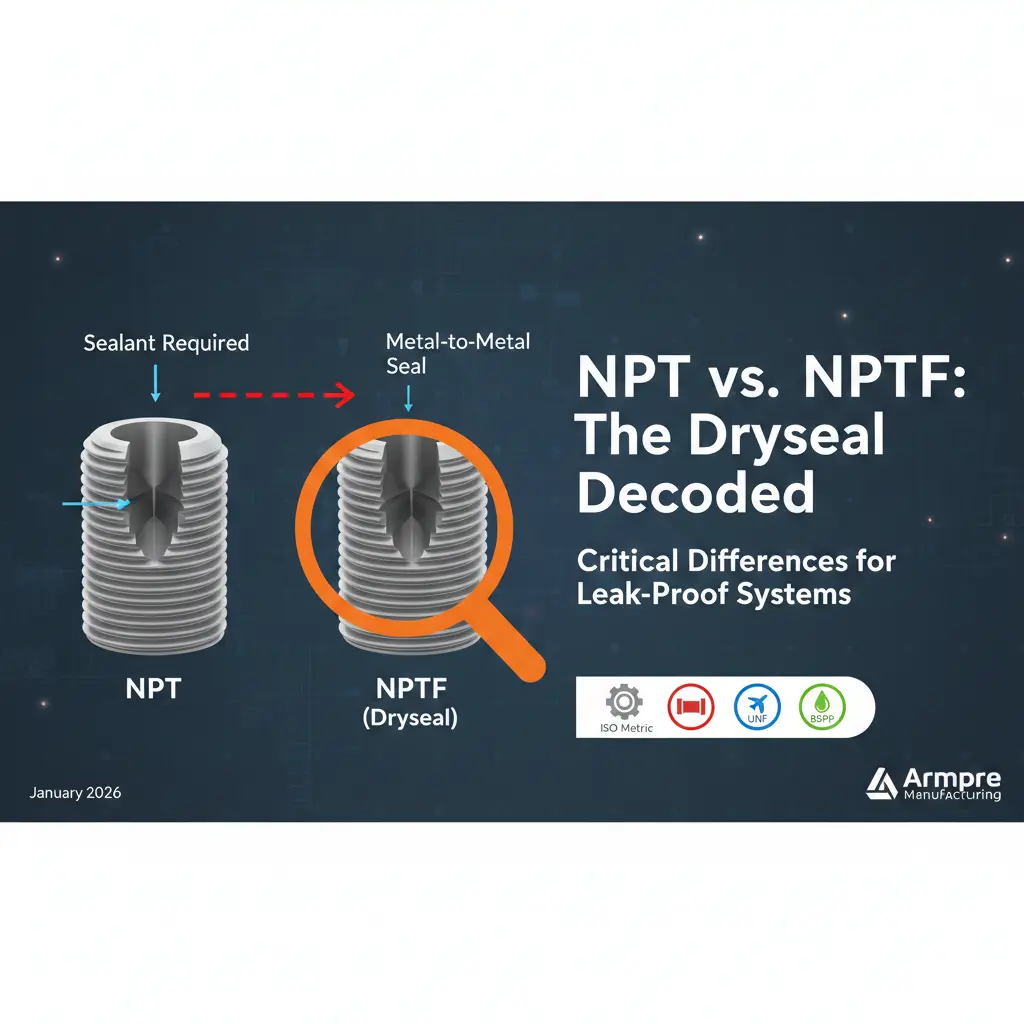
NPT (National Pipe Taper) and NPTF (National Pipe Taper Fuel) threads may look identical to the naked eye, as both share a 1:16 taper rate and 60° thread angle defined by ASME B1.20.1 and ASME B1.20.3. However, the functional difference lies in their crest and root truncation.
While NPT requires a sealant (like PTFE tape) to fill the clearance between the crest and root, NPTF (Dryseal) is designed to create a leak-proof, metal-to-metal seal through mechanical crushing of the thread peaks into the roots. This makes NPTF essential for critical applications where sealants could contaminate the system, such as fuel lines and high-pressure hydraulics.
Technical Standard: Dryseal
This comparison guide adheres to ASME B1.20.3 standards for Dryseal pipe threads. Note: While an NPTF male thread can fit into an NPT female port, it will lose its "Dryseal" capability and must be treated as a standard NPT connection requiring sealant.
Quick Navigation
-
NPT vs NPTF Comparison Table: Key differences in crest/root design.
-
The Dryseal Principle: How metal-to-metal interference works.
-
Interchangeability Guide: Can you mix NPT and NPTF components?
-
Application Checklist: When to choose NPTF over standard NPT.
| Nominal Size (Inch) | Threads Per Inch (TPI) | NPT Sealing Type | NPTF (Dryseal) Sealing | Interchangeable? |
|---|---|---|---|---|
| 1/8 - 27 | 27 | Sealant Required | Metal-to-Metal | Yes (with sealant) |
| 1/4 - 18 | 18 | Sealant Required | Metal-to-Metal | Yes (with sealant) |
| 3/8 - 18 | 18 | Sealant Required | Metal-to-Metal | Yes (with sealant) |
| 1/2 - 14 | 14 | Sealant Required | Metal-to-Metal | Yes (with sealant) |
| 3/4 - 14 | 14 | Sealant Required | Metal-to-Metal | Yes (with sealant) |
| 1 - 11.5 | 11.5 | Sealant Required | Metal-to-Metal | Yes (with sealant) |
When our American client starts tapping work, they always make NPT tapping, which stands for National Pipe Taper.
which is widely applied in many different applications, such as: Fuel Systems, Pumps, Regulators, Filters, Aftermarket Brake Calipers,
Oil & Coolant Passages in Intake Manifolds, Cylinder Heads, Engine Blocks, Gauges, Etc.
also known as ANSI/ASME B1.20.1 pipe threads.
It is a U.S. standard for measuring tapered threads.
Unlike straight threads, a taper thread will provide a closer seal.
Commonly applied sizes include: 1/8, ¼, 3/8, ½, ¾, 1, 1 ¼, 1 ½, and 2 in.
When the tapping materials are ready, the taps and tapping machine are received from Armpro Machine. The job is now out in your shop to be done, while the first procedure is to drill a hole before tapping.
How do you think what should be done?
Holes before tapping are produced either straight or tapered, up to your metal working experiences, some will take additional reaming operation on the hole, which can achieve a better finish and reduce tapping torque.
A straight-drilled hole that has not been reamed has a much larger volume of chip removal during tapping. That tap has to not only cut the thread but shape the hole to the correct taper, so more material is removed in the process compared with a reamed hole. Every tooth is cutting a new chip like the chamfer of a cylindrical tap. So some clients may take an interrupted-thread tapper tap for better performance
However tappered or straight hole size needs to be small enough so that the tap produces 100% of the product thread form, whether the hole with or without taper reaming needs to be deep enough to meet the thread requirement. Also depend on the materials, tapping operation, and the type of drill, it is advised that you run a trial work before running a large quantity of parts
The chart below showing suggested drill size and depth, good size hole to achieve good tap performance when doing NPT Tapping.
“While NPTF focuses on the sealing mechanism, you can find the full dimensional data in our NPT Thread Size Chart.”
Can NPT and NPTF be used together?
Yes, they are physically compatible, but the 'Dryseal' feature is lost. If you mix NPT and NPTF, you must use a thread sealant to ensure a leak-proof connection.
What does NPTF stand for?
NPTF stands for National Pipe Taper Fuel, also known as Dryseal American National Standard Taper Pipe Thread.
Can NPTF threads be reused after being disassembled?
While NPTF threads are designed for a "one-time" superior seal through metal-to-metal interference, they can often be reused if the threads show no signs of galling or excessive deformation. However, upon reassembly, the "Dryseal" capability may be compromised. It is standard engineering practice to apply thread sealant (like PTFE tape) during reinstallation to compensate for the permanent deformation of the thread crests from the initial seating.
What gauges are required to inspect NPTF vs. NPT threads?
This is a critical distinction in quality control. NPT threads are typically inspected using a single L1 plug or ring gauge to check functional hand-tight thickness. However, NPTF inspection requires a coordinated 3-gauge system (L1, L2 or L3, and 6-step crest/root gauges) to ensure that the crest and root truncation fall within the strict limits necessary to achieve a Dryseal interference fit.